

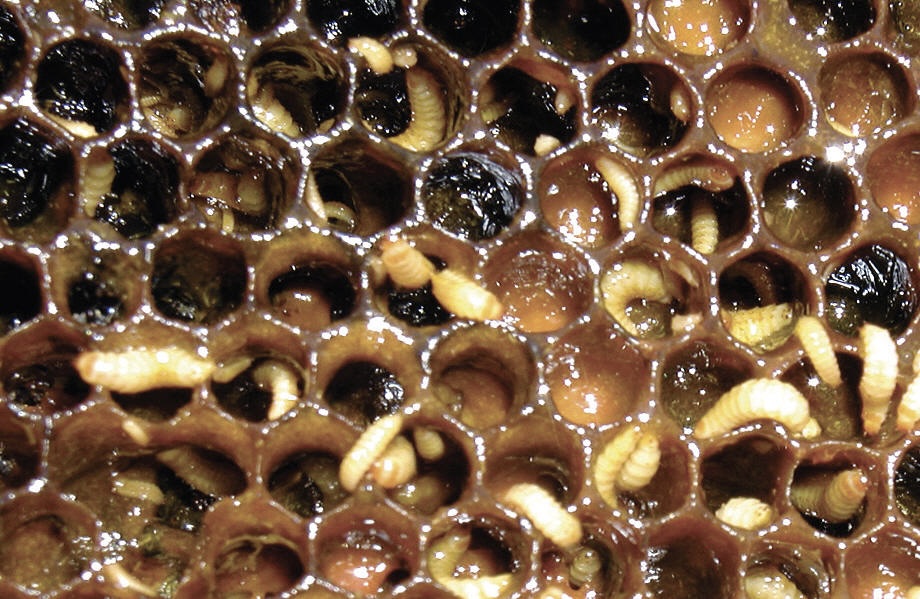

A few years ago, when I opened a hive for inspection, I was greeted by slimy, smelly honey and brood frames. Adult small hive beetles (SHBs) were scurrying across the inner cover and on the frames headed for deeper darker places in the hive. Fast moving larvae were wiggling in and out of cells on brood nest and honey frames, defecating everywhere and spreading yeast (K.Omerhi) causing the honey to ferment. The SHB larvae and adults were eating bee bread and ruined honey, denying the bees necessary nutrition. It was disgusting! There were a few bees in the hive but most were wise enough to abscond.
During my hive autopsy I found three likely interactional factors that may have contributed to the colony’s downfall: a high varroa count (despite regular testing and treatments), a queen not bred for hygienic behaviors targeting varroa mites, and extremely rich, warm, loose and moist soil in my apiary. These soil conditions are perfect for pupating larvae to fully develop. The warmer and moister the soil the more quickly the SHBs develop (~2-3 weeks). Global warming promises to make the soil here and around the world even more hospitable for SHB larvae to pupate successfully. (1) Newly minted young adults emerge from the soil seeking hives to occupy. Once the young SHBs sexually mature they mate, and females start laying prolifically. And so it goes. One female SHB alone can lay up to 1000 eggs in her lifetime! The other hives in my apiary also had many SHBs. They, too, were tested and treated for varroa at the same time. These colonies survived but needed my help.
Here I’m focusing on SHBs because they can seriously weaken a colony on their own if bees can’t herd and jail them. After a deep dive into research on managing SHBs I assembled and very informally tested two “homegrown” IPM methods I hoped would help the bees manage SHBs by minimizing reproductive success. Hopefully, this post will encourage discussion about others’ experiences with SHBs and sharing ideas that were helpful and/or unhelpful at managing SHBs in your hives. (Please note: I didn’t use Coumaphos and/or Permethrin based products so they aren’t discussed here.)
Having SHBs in a hive is not an automatic death sentence to be sure, but there is no silver bullet to eradicate them. Unlike with varroa, there is no established threshold or treatment. SHBs are a global threat to colony survival, and cause significant personal income and macro economic losses. (2) Currently, there is a lot of hopeful research in progress studying biological methods to minimize SHBs. (3, 4, 5) But until those results are commercially available, all we can do is use available resources to help the bees manage SHBs as needed. Planning two-pronged interventions, in-hive methods to kill adults and external methods to keep pupating larvae from reaching full development can help minimize SHBs’ reproductive success, per experts Drs. Peter Neumann and Jamie Ellis. (6) I took their advice seriously and explored some proactive and creative ways to help the bees keep SHBs in their hive in check.
I assembled and tested two intervention methods: a “System” including an “interceptor” trap designed by entomologists for their own research purposes involving SHB larvae. (7) I hoped the System would capture and drown SHB larvae before they reached the ground to pupate. The second is a “Hybrid” method that I thought would keep the adult SHB adult numbers low in the hive and minimize pupating larvae fully developing in the soil. I’ll share the makeup of the “System” and the “Hybrid”, my “test” method, some anecdotal observations, lessons learned and next steps.
“System” and “Hybrid” methods
Each method has both in-hive and external components described here. The “System” was designed to: a) minimize adult SHB numbers inside the hive so the bees can manage them more successfully; b) keep pupating SHB from achieving full development; c) avoid colony infestation and loss. It involves four mechanical IPM components: 1) Freeman Small Hive Beetle Oil Trap placed under the bottom board; 2) a Beetle Baffle affixed to the top of the bottom board walls that would, hopefully, interfere with wandering larvae on the bottom board from leaving the hive to pupate and obstruct entry of newly emerged young adult SHBs from getting into the hive; 3) an open capture and drown trough trap attached to the rear of the bottom board and, 4), an “interceptor trough trap” (ITT) attached flush with the front of the bottom board to intercept wandering larvae as they jump off to reach the soil to pupate. (7) The capture and drown traps were all filled with concentrated soapy water. I tested the System two ways. One test was in vivo (apiary) and the second was slightly more controlled (driveway). I installed the System on a hive with a lot of hive beetles in an apiary in Philadelphia. (Thanks to Dave Harrod for his support of this project and kindly volunteering a hive in his apiary for the test!)
A word about the interceptor trap:

filled with concentrated soapy water.
The “interceptor” trough trap (ITT) (my acronym) was designed by entomology researchers that were studying interception of wandering SHB larvae (~10 to 17 days old) as they jump off the front of the bottom board headed for the soil to pupate. (7). Their study was conducted under very controlled temperature and light conditions. No bees were involved nor did the researchers recommend using the trap on active beehives. I made the ITT part of the System anyway. I tested the System in vivo in an active beehive with numerous adult SHBs. I hoped the outcome would give me some ideas for adapting it for use on an active beehive. (Thank you to entomology researchers Dr. Jamie Ellis and Dr. Charlie Stuhl, USDA for helping me track down the ITTs (Dr. Ellis) and to Dr. Stuhl for sending me the interceptor traps).
The researchers placed 100 larvae of all ages in an empty beehive with the ITT attached to the front of the bottom board. It intercepted and drowned 87.2-94.2% of the 100 larvae they started with. (7) I had no illusions that my test hive outcome would come close to theirs!
Out of curiosity, I installed a System on an empty hive on my asphalt driveway, about 10 feet from my garden. I placed 25 larvae and a small amount of protein substitute in the middle of a screened bottom board for two weeks, checking the traps every few days, keeping count of the number of dead larvae in the ITT, rear trough and in-hive Freeman trap.
The second or “Hybrid” method is much simpler. It has two components: multiple Baitable Beetle Jails (BBJs) placed throughout the hive. The middle well was filled with apple cider vinegar as the attractant and the wells on either side contained viscous mineral oil to drown SHBs that fall in. They were placed in the hive between frames, slightly enlarging the bee space, but the bees didn’t appear to mind. The second component was beneficial nematodes, Heteorhabiditis indica (H.I.) and Steinernema riobrave (S.R.) purchased from Southeastern Insectaries, LLC, where nematode-SHB research has been conducted. These species are known to eat pupating SHB larvae, preventing them from fully developing into adulthood and invading hives. (8, 4) I spread the nematodes around the perimeter of the hives. (Note: I ordered two packages of H.I. nematodes but received one package of H.I. and one of S.R. Since this project was about minimizing reproductive success rather than efficacy of one nematode species compared to the other I spread both.)
Observations:
In vivo System trap: The results of the in vivo active beehive test were disappointing but not surprising. The interceptor trap had 2 dead larvae and the Freeman Oil SHB Trap had 2. There were no dead larvae in the rear trough. There was a lot of debris in the traps but no dead bees were found in any of the traps. Most of the soapy water had evaporated by two weeks which may be a factor in the poor performance. The Freeman trap requires the hive be level which this hive was not. Not much to write home about!
Driveway System observations: The System on the empty hive was more successful. Of the starting 25 larvae, 4 died in and near the food dish. The ITT intercepted and drowned 11 larvae and the Freeman trap captured and drowned 4 larvae. I accounted for all but 6 (24%) of the original 25 larvae.
Hybrid method:
I replaced old BBJ traps with new, clean freshly filled traps in preparation for this small test. Some of the mineral oil wells in the old traps were half filled with dead adult beetles. I did periodic inspection over two weeks. Relatively few SHBs were in the brood nest traps. I can’t definitively say the Hybrid method was successful, but the results motivate me to repeat the testing this summer, using a more rigorous protocol.
The good news? Research into biological methods for managing SHBs includes soil characteristics, pheromones, nematodes and particular odors are very promising. (3,4,5) While we’re waiting for more tools, we have existing resources, proactivity and vigilance to protect our bees and minimize SHB reproductive success.
Lessons learned and next steps:
One of the biggest lessons I learned was to be vigilant and proactive: Managing small hive beetles begins in early spring when SHB winter survivors emerge and begin laying anywhere they can. Monitoring SHBs is now a routine step during my inspections, especially as the soil temperature and moisture rise during spring and summer. In fall, I am constantly mindful of minimizing the number of SHBs that overwinter with the colony and eat their food. This task is on my overwintering preparation checklist. I decided against putting clay around my hives’s perimeter to interfere with larvae digging down next/near hives to pupate. SHB larvae travel far beyond the hive perimeter to find good soil for pupating.
I’ll continue striving to keep my colonies strong and healthy. This entails: regularly testing and treating colonies for varroa, keeping numbers at or below the threshold of 2 mites per 100 bees in spring and summer. I’ll also invest in queens bred for hygienic behaviors. They can make a difference in varroa numbers, colony strength and survival. A strong colony enables the bees to herd and jail SHB adults, reducing mating and egg laying in the hive.
As a result of this imperfect project, I won’t use the Freeman Small Hive Beetle Oil Trap because it requires that the hive is level, which mine are not; I will not use a trough trap on the back of the bottom board. I will use Baitable Beetle Jails and/dryer sheets inside the hive; I will continue to use beneficial nematodes throughout the season; I will continue to use beetle baffles; and I will make some adjustments to the interceptor trap and use that as well.
I will experiment with lining the walls inside the bottom board with 60 grit sandpaper to possibly keep larvae from leaving the hive. (10)
During hive inspections I’ll explore how useful an inverted outer cover is at helping “guesstimate” SHB levels in the hive. Regardless of guesstimate potential, I can kill as many adult SHBs in the outer cover as I can catch! (BTW: Killing the SHBs in the inverted outer cover can be satisfying for the beekeeper, but isn’t a replacement for other methods.) Both mineral oil and soapy water can be used as drowning agents in traps. Both are very slippery, messy and hard to work with. Bees die on contact with either substance! I settled on mineral oil because it evaporates very slowly. Thanks to Vince Aloyo for recommending using condiment squeeze bottles for filling the attractant (apple cider vinegar) and mineral oil wells in the Baitable Beetle Jails. These squirt more directly, create less of a mess and kill fewer bees. A definite improvement over pouring from bottles!
If I should change to using concentrated soapy water (vs. slow evaporating mineral oil) to drown SHB adults and larvae I’ll add glycerin to slow down evaporation.
Protein patties used to feed bees in early spring is co-opted by SHBs for food and breeding. They lay eggs in the protein patties, depriving bees of nutrients. The eggs hatch quickly in warm months and the larvae eat the patty. They wander out of the hive to pupate in the soil. I’ll place small patty pieces on frame tops and vigilantly check and replace these regularly to help minimize reproductive success inside the hive.
Before and after test assessment: There is a SHB research protocol that will inform future testing, including estimating SHB numbers in a hive before and after intervention.
SHB infested frames can be salvaged and reused by filling a large plastic container with soapy water. This method worked well. I placed the infested frames in a large plastic container filled with concentrated soapy water, covered the container, and periodically checked if the larvae drowned. After the larvae died I thoroughly rinsed the frames and froze them for a few days to make sure all of the larvae and eggs were killed. I returned the clean frames to their hives for the bees to repair and reuse. Warning: This is a very unpleasant task!
I hope this information is helpful. Please feel free to post about your own interventions and any suggestions you have for minimizing SHB reproductive success.
Thank you to all who helped me complete this project:
Dave Harrod; Jeff Eckel; Frank Ruthkowsky, Dr. Robin Underwood; Dr. Jamie Ellis; Dr. Charlie Stuhl, Dr. David Shapiro and Phil Tedders.
References:
1) Global warming promotes biological invasion of a honey bee pest
Bram Cornelissen, Peter Neumann, Oliver Schweiger
August, 8, 2019, https://doi.org/10.1111/gcb.14791
2) Bram (A.C.M.) Cornelissen & Peter Neumann (2022) Invasive species require global efforts: COLOSS task force Small Hive Beetle, Bee World, 99:1, 29-31, DOI: 10.1080/0005772X.2021.2008166
3) Stuhl, C. J., & Teal, P. E. (2023). A potential pheromone for the mass trapping of Aethina tumida (Coleoptera: Nitidulidae). Florida Entomologist, 106(2), 83-89.
4) Sanchez, W., Shapiro, D., Williams, G., & Lawrence, K. (2021). Entomopathogenic nematode management of small hive beetles () in three native Alabama soils under low moisture conditions. Journal of Nematology, 53(1), 1-14.
5) Komen, Ednah Jebet. Evaluation of Apicure, a plant-based extract for the management of the small hive beetle, Aethina tumida. Diss. JKUAT-CoANRE, 2022.
6) Two Bees in a Podcast, Episode 148. Dr. Jamie Ellis and Amy Vu speak with Dr. Peter Neumann about small hive beetles.
7) Richard T. Arbogast, Baldwyn Torto, Steve Willms, Ayuka T. Fombong, Adrian Duehl, Peter E. A. Teal, Estimating Reproductive Success of Aethina tumida (Coleoptera: Nitidulidae) in Honey Bee Colonies by Trapping Emigrating Larvae, Environmental Entomology, Volume 41, Issue 1, 1 February 2012, Pages 152–158, https://doi.org/10.1603/EN11186
8) Dr. David Shapiro, entomology researcher, USDA, telephone conversation about effectiveness of nematodes HI and SR.
9) Bram Cornelissen, Peter Neumann. (2018) How to Catch a Small Beetle: Top Tips for Visually Screening Honey Bee Colonies for Small Hive Beetles, Bee World, 95:3, 99-102, DOI: 10.1080/0005772X.2018.1465374
10) Karsten Stief, Bram Cornelissen, James D Ellis & Marc O Schäfer (2020) Controlling small hive beetles, Aethina tumida, in western honey bee (Apis mellifera) colonies by trapping wandering beetle larvae, Journal of Apicultural Research, 59:4, 539-545, DOI: 10.1080/00218839.2020.1720138
Resources:
Bram (A.C.M.) Cornelissen & Peter Neumann (2022) Invasive Species Require Global Efforts: COLOSS Task Force Small Hive Beetle, Bee World, 99:1, 29-31, DOI: 10.1080/0005772X.2021.2008166
COLOSS.Org
COLOSS.org COLOSS BEE BOOK, Standard Methods for Apis Mellifera Research, Volumes 1, 2, 3. Includes a chapter about methods for studying SHBs.
COLOSS.Org link: https://coloss.org/profile/login/?redirect_to=https://coloss.org/ec-election-candidates-2022/
COLOSS Takes on the small hive beetle: https://beekeep.info/articles/coloss-takes-on-the-small-hive-beetle/
David I. Shapiro-Ilan,1 Richou Han,2 and Claudia Dolinksi3
Entomopathogenic Nematode Production and Application Technology
J Nematol. 2012 Jun; 44(2): 206–217. PMCID: PMC3578468PMID: 23482883
Honey Bee Suite:
https://www.honeybeesuite.com/absconding-or-ccd/
https://www.honeybeesuite.com/slippery-life-small-hive-beetle/
Neumann, P., Pettis, J. S., & Schäfer, M. O. (2016). Quo vadis Aethina tumida? Biology and control of small hive beetles. Apidologie, 47, 427-466. https://link.springer.com/article/10.1007/s13592-016-0426-x
Neumann, Peter, and Lars Straub. “Beekeeping under climate change.” Journal of Apicultural Research 62.5 (2023): 963-968.
Penn State Unversity Extension:
https://pollinators.psu.edu/assets/uploads/documents/Methods-to-Control-Varroa-Mites-An-Integrated-Pest-Management-Approach.pdf
https://extension.psu.edu/pollinator-declines
Roth, Morgan A., James M. Wilson, and Aaron D. Gross. “Biology and management of small hive beetles (Coleoptera: Nitidulidae): A pest of European honey bee (Hymenoptera: Apidae) colonies.” Journal of Integrated Pest Management 13.1 (2022):7
Sammataro, Diana and Alphonse Avitabile. (2021) The Beekeeper’s Handbook, 5th Edition, Cornell University Press.
Small Hive Beetle Management in Mississippi
Authors: Audrey B. Sheridan, Research/Extension Associate,
Department of Biochemistry, Molecular Biology, Entomology and
Plant Pathology, Mississippi State University; Harry Fulton, State
Entomologist (retired); Jon Zawislak, Department of Entomology,
University of Arkansas Division of Agriculture, Cooperative
Extension Service
Link:
https://www.google.com/search?q=Small+Hive+Beetle+Management+in+Mississippi
&rlz=1C9BKJA_enUS920US921&hl=en-US&sourceid=chrome-mobile&ie=UTF-8
Phillip Tedders, Owner and operator of South Eastern Insectaries, LLC, nematodes.
Jon Zawislak, Department of Entomology,
University of Arkansas Division of Agriculture, Cooperative
Extension Service. Small Hive Beetle lecture.

https://m.youtube.com/watch?
Comprehensive article about small hive beetles: