
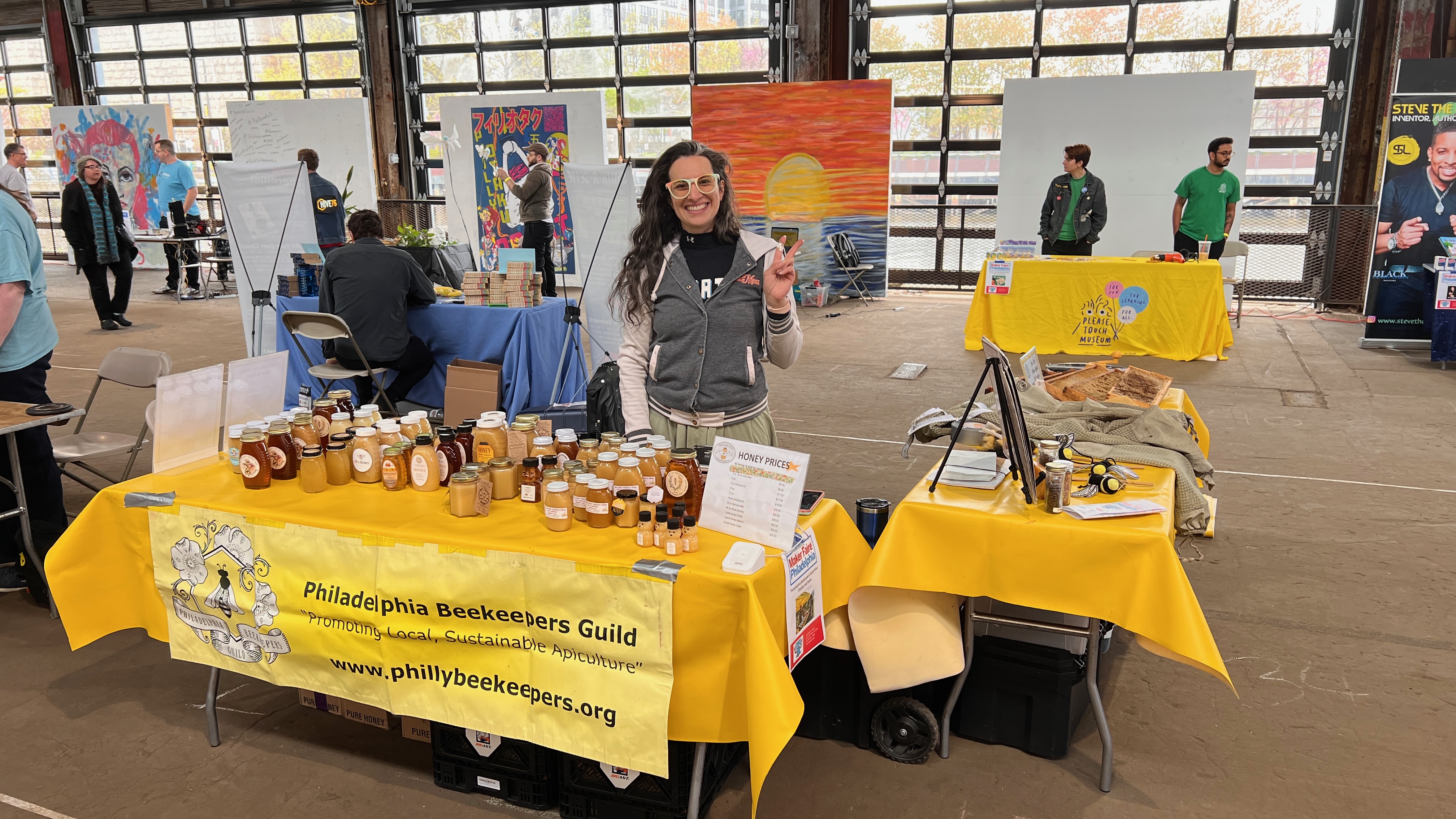
Beekeeping is a wonderful thing to do. Bees are fascinating, amazing, a little dangerous, and essential. If you’ve taken it up and you’ve been able to keep them alive over winter and harvest honey in the summer, well you’ve got something to be proud of. It’s not that easy!
But what do you do with the honey? People are surprised when they hear that a colony will produce 50-100 pounds of honey (or more) every year. If you have two or three or fifty hives what are you going to do with all that honey?
The Guild was, in part, set up to help you deal with this issue.
Honeyfest and beyond
In 2009 we started Honey Fest to celebrate beekeeping in Philadelphia and to help our members sell their honey. Honey Fest has grown over the years and we’ve expanded our honey selling events to the point that the Guild sold over $20K worth of honey in 2023 and paid out over $16K to the beekeepers. That’s over $1,000 per beekeeper on average and there’s no reason you shouldn’t be getting a share of that. If that sounds good to you, read on…
Requirements for Guild Consignment:
- You are a current member at the Hobbyist or Beekeeper levels.
- You are selling honey that your bees have made. No reselling.
- Your honey was extracted and bottled in a certified honey kitchen or other approved facility. We do require documentation. Our honey kitchen at Awbury is an approved facility. More on state regulations here.
- Your honey is packaged in one of the containers sizes indicated in the form below. We can’t accept other sizes.
- Your label conforms to state labeling guidelines.
- We encourage you to indicate the zip code or location of your apiary, if possible. We find that specific location information sells honey.
- You are able to drop off and pick up your honey at Guild designated locations. No shipping
- You commit to volunteer for at least two(2) shifts or events of at least four(4) hours in addition to Honey Fest. We find that honey sells better when customers can talk to the beekeeper in person. If we have fewer events than we have volunteers, we will waive this requirement on a year-by-year basis.
We start selling in April most years and continue through the fall. Average sales for a full season are around $1,000 per beekeeper.
You MUST show up to sell your honey
(or send someone in your place). We break longer events into 4 hour shifts, and we expect everyone selling honey to do a shift at Honey Fest.
Please LOG IN and fill out the form below to let us know that you’d like to consign honey.
If you can see the form then you are logged in and your membership qualifies for honey sales.
After you’ve gotten training and attended an event we’ll add your honey to our inventory.
We generally keep the honey until it’s all sold unless you ask for it back. Our biggest sales event is Honey Fest in September, but we have events from April to November and eventually most of it sells out.
Pricing
All sizes are BY WEIGHT. Honey is always sold by weight. Because honey is much denser than water, this means that the volume of the jar is less than the weight. Honey jars are usually sold by the weight they will hold. We include pint and quart jars because they are common and often used by our members. Let us know if you have questions about a specific jar that you want to use.
| All honey is sold by weight | Price |
| 2 oz. jar or baby bear | $3.00 |
| 6 oz | $8.00 |
| 8 oz (half pound) | $11.00 |
| 10 oz | $13.00 |
| 12 oz | $14.00 |
| 16 oz (one pound) | $18.00 |
| 32 oz (two pounds) | $30.00 |
| 48 oz (three pounds) | $38.00 |
| Comb Honey Small | $20.00 |
| Comb Honey Medium | $25.00 |
| Comb Honey Large | $30.00 |
- State Regulations: We are retailing your honey, so it must be packed according to PA State regulations. If you use our honey kitchen you will be in compliance. We really want you to use the honey kitchen if you can!
- If you don’t want to use our honey kitchen you can register your facility (kitchen, garage, basement, etc.) There are a number of publications that cover processing and labeling of honey.
- ‘Selling Honey in PA‘ is a document from Karen Roccasecca, our State Apiarist. Follow the directions under the heading 2. If honey producer sells off-site of his or her farm. The document also contains labeling guidelines.
- GUIDELINES FOR HONEY PROCESSORS IN PA is a publication from the PA Dept. of Agriculture. It covers a lot of the same ground as the document above, with more detail on handling and the criteria that the inspector will use to evaluate your honey kitchen.
- Limited Food Establishments is a PA Dept. of Agriculture page that explains why a honey kitchen is considered ‘limited’ and has a link to the (rather long) form that you need to apply for this type of license.
- Suggestions: We have found certain things to be helpful when selling honey at our events.
- Location: You have to provide an address and your name on your label. We find that honey that is labeled with the specific location of the apiary, at least at the zip code level, sells better. Part of the appeal of what we’re doing is that the honey is LOCAL, so letting people know where the bees lived helps.
- Crystallization: crystallized honey, unless it’s creamed honey, does not sell as well as liquid honey. We all know there’s nothing wrong with it, it’s a natural process, etc. We explain that to customers but it doesn’t help much. If your honey is crystallized it probably won’t sell well.
- Being there: The single most powerful sales tool is to attend the event and talk to customers. If you can make it out to any event to talk to people directly you will sell more honey.
- Your Story: If you can’t be there the more information you can give us about your honey and your history in beekeeping the better. Our sellers – you guys – do learn each other’s stories and it really helps when we can talk to the customer about what differentiates your product.
- Jars or Containers: We accept the sizes (by weight) above. Many different jars are available in these sizes and you can use any jar you like as long as it is one of the sizes we list. We haven’t really noticed any advantage or disadvantage to different jars. Remember that honey is 50% heavier than water for the same volume so a pint of honey (volume) will weigh a pound and a half.