

New Orleans, LA
January 10-13, 2024
Ellen Codd
Tropilaelaps Mites—A Fate Worse Than Varroa.
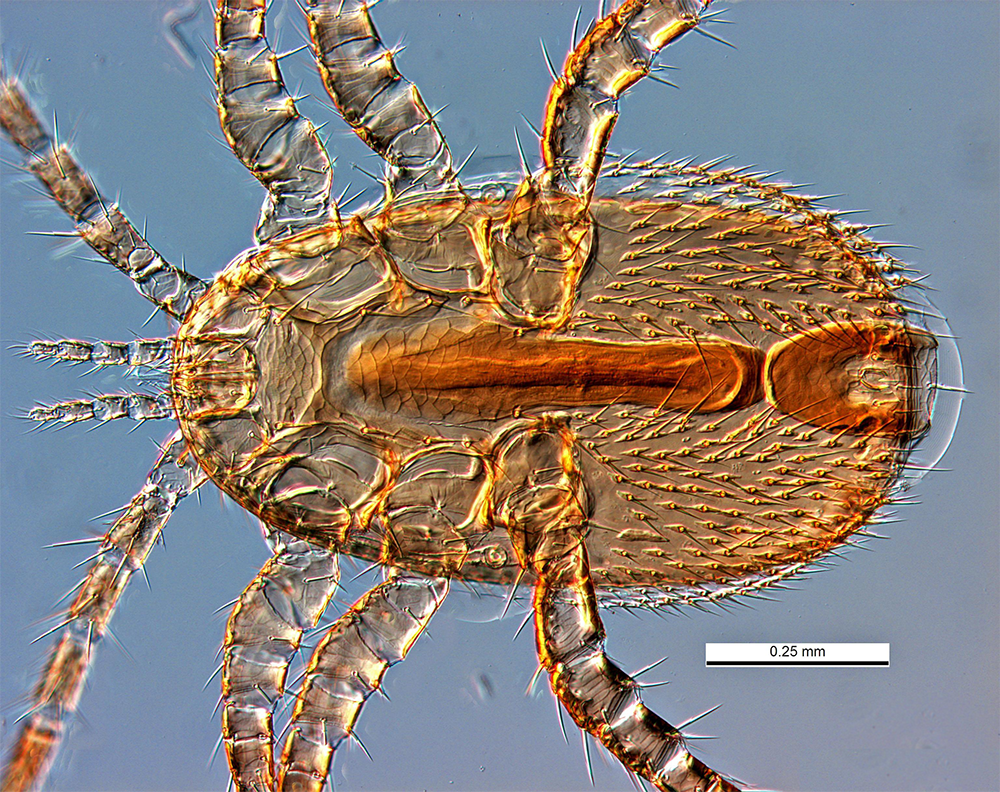
Dr. Samuel Ramsey has been studying Tropilaelaps mites in Thailand and other places for some years now, and many of us have heard “the latest” on his work on them. With their presence now in Ukraine, a country from which Canada imports honey bees, Tropilaelaps have moved from being “interesting” to being of imminent concern. With a reproduction rate much higher than that of Varroa, vectoring a (known) expanding number of viruses, and annual hive losses moving from <10% to >60% in the wake of their arrival, Tropilaelaps pose a serious threat to world wide beekeeping.
In approaching this threat, Dr. Ramsey is focusing on two goals, monitoring their presence/level in hives and killing them. Because most of their life cycle is spent inside cells in the hive, neither alcohol wash nor sugar shake monitoring used for Varroa work for Tropilaelaps. Sammy is trying to develop a test akin to a covid rapid test as a tool, as well as a low-tech glue-on-a-transparency (as in a transparency for an overhead projector) to pick up mites on the face of a frame.
Dr. Ramsey has studied some possible treatments, including a heating (the hive or frames) method and use of various formic acid applications. Formic Pro does greatly reduce the Tropilaelaps population, but the rapid reproduction rate of these mites suggests that treatment would have to be applied more frequently.
In what I see as Dr. Ramsey’s unique ability to think differently about a scientific problem, he has been musing about the HUGE size of the eggs laid by varroa and Tropilaelaps, a varroa egg weighing about 28% of the weight of a non-gravid female mite. This observation led him to think about how they accomplish that and to communicate with scientists working with a few other insects who engage in somewhat similar behaviors (producing offspring that are huge compared to the size of the mother). To cut to the result, Dr. Ramsey has discovered that, unlike most animals that eat protein, digest it down to its component pieces, and then reassemble the pieces to make new proteins, Varroa and Tropilaelaps just take the bee proteins in and use them as is—bee proteins = mite proteins! See: https://www.biorxiv.org/content/10.1101/2022.09.30.509900v1
Apparently, Varroa need some proteins that are present in adult but not developing honey bees, whereas Tropilaelaps obtain all their needed proteins from honey bee larvae and pupa, so that Tropilaelaps mites do not spend a week or so out and about in the hive feeding on adult bees before entering a larvae-containing cell to continue to reproduce. Dr. Ramsey is thinking about how to target this “protein harvesting” machinery in the mites, a process he has named “kleptocytosis,” as disruption of this machinery would interfere with egg yolk production and therefore render the eggs unable to support growth of an offspring. His message is that Tropilaelaps is coming sooner than we like to think, and they will make Varroa look easy to deal with. A Dr. Ramsey video on Tropilaelaps: https://www.youtube.com/watch?v=-JH9RAZzrAg
Synthetic honey. In a panel discussion held in a commercial beekeeper track and chaired by Tim Wilbanks, Blake Shook spoke about “synthetic honey.” According to Mr. Shook there are two companies working in this space, each having different technology and targeting different customers.
MeliBio (https://www.melibio.com/) is taking nectar (don’t know how they gather it) and fermenting it using enzymes (like those in a bee’s honey stomach) to make “honey.” This company is targeting food service industries and is trying to capitalize on “save the bees” by making bee-free honey (similar to lab grown meat that is made without killing animals).
Bee-IO (https://bee-io.com/) is using plant cells to produce nectar that is then processed with cells from honey bees to produce “honey.” By taking cells from different plants, Bee-IO can produce varietal “honeys.” They advertise that they save the bees for their “traditional work of pollination,” that their “honey” is pesticide free and safe for babies, etc.
The speaker warned that the lack of a legal definition of honey in the US (elsewhere?) leaves the beekeeping industry open, as these companies can call their product “honey,” a problem the speaker likened to that facing the dairy industry, now impacted by almond, oat and soy “milks.” Presently, the speaker said these companies are challenged to make their processes cost-effective, but that may change.